In this guide · 7 sections
- Stock attendance is not merely being present at the warehouse. The file should show what was observed, which test counts were performed, how movement was controlled and how the final inventory listing was reconciled.
- Plan, perform, evidence and conclude are four separate parts of a defensible audit step.
- A clear working-paper reference and reviewer conclusion matter as much as the checklist tick.
Try SignReady: Keep the procedure, evidence and conclusion in one review-ready audit file.
Start freeStock attendance is not merely being present at the warehouse. The file should show what was observed, which test counts were performed, how movement was controlled and how the final inventory listing was reconciled.
What the auditor needs to establish
Start with the audit objective and the assertion at risk. A good file lets a reviewer see the population or matter examined, why the procedure was selected, what evidence was obtained, exceptions found and the conclusion reached. The steps below are a practical framework; they must be tailored to the engagement, assessed risks and applicable reporting framework.
Use SignReady to keep the procedure, evidence, open query and partner conclusion together. Start with 3 finalisations free.
A practical procedure
- Plan before the count: locations, material categories, count instructions, cut-off documents, high-value/slow-moving items and independent staff.
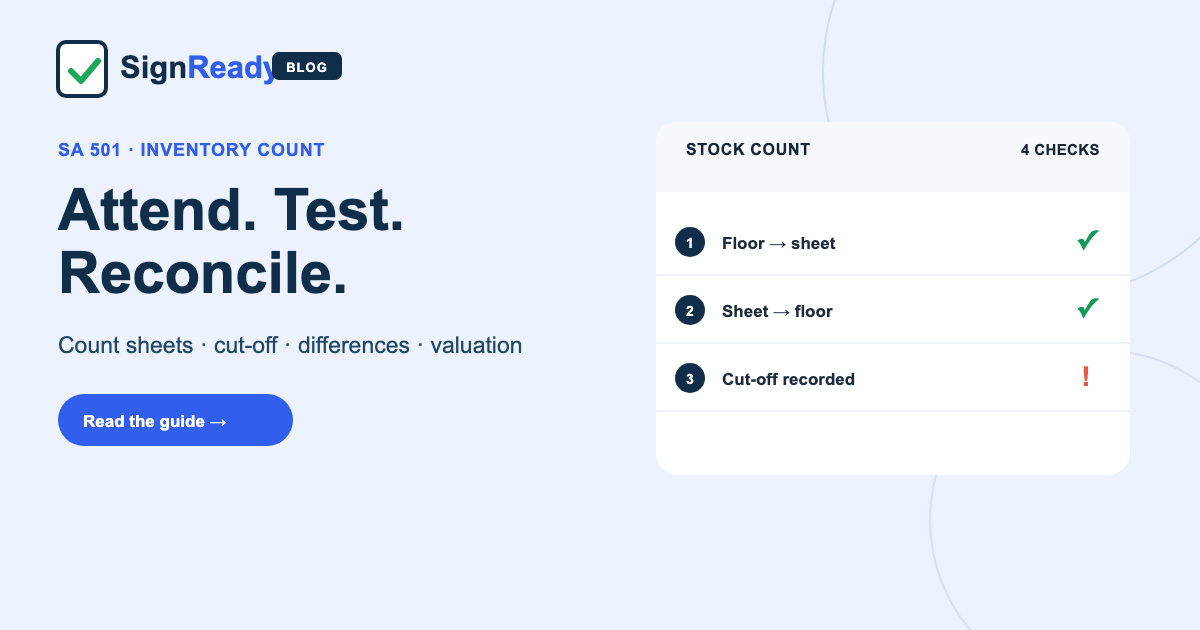
- At attendance, observe management’s controls, perform floor-to-sheet and sheet-to-floor test counts, note damaged or third-party stock, and record last goods-received and dispatch numbers.
- Reconcile the final count sheets and valuation summary to the inventory listing and trial balance; investigate material differences.
- Where attendance is impracticable or the count date differs from year end, perform appropriate alternative or roll-back/roll-forward procedures and document why they are sufficient.
How to document the work
| Record | What it should show |
|---|---|
| Purpose and risk | The assertion, population or issue being addressed and why the work is necessary for this client. |
| Work performed | Who performed it, date, population/selection where relevant, documents inspected and tests completed. |
| Evidence and exceptions | Working-paper references, copies or links to evidence, exceptions and follow-up. |
| Conclusion and review | A clear conclusion against the objective, effect on the financial statements/report, reviewer comments and closure. |
In SignReady, use the relevant programme area to attach the evidence, raise exceptions as review points and record the conclusion before final partner sign-off. That is a workflow benefit—not a substitute for professional judgement or the underlying procedures.
Common mistakes
- Only retaining a signed stock certificate.
- Testing quantity but not condition, ownership, cut-off and valuation.
- Failing to record count-sheet ranges or movements during the count.
Final review questions
- Does the work respond to the specific risk, rather than a generic checklist?
- Could another experienced auditor understand what was tested and why?
- Are all exceptions resolved, quantified or carried into the final evaluation?
- Does the conclusion link to the financial statements or reporting decision?
Try SignReady: Give your reviewer the workpaper reference, conclusion and open points in one place.
Start freeFrequently asked questions
Can I use this as a standard audit checklist?
Use it as a starting framework only. Tailor the objective, procedures, selection and conclusion to the entity, assessed risks and applicable standards.
What makes a working paper review-ready?
It identifies the objective, work performed, evidence, exceptions, conclusion, preparer and reviewer. A tick without that trail is rarely enough.
Can SignReady replace professional judgement?
No. SignReady organises work, evidence, review points and finalisation. The auditor remains responsible for the audit procedures, conclusions and report.
Sources
SignReady brings your trial balance, working papers, review points and finalisation checks into the same client file. Start free — 3 finalisations.
Audit and accounts updates, practical tips and knowledge: join the Audit and Accounts Update group on WhatsApp.
Version history: 18 Nov 2026 — first published. This guide is part of SignReady's audit-procedures series. It links the audit objective, procedures, evidence and conclusion so the work can be reviewed properly.


